Fight for the broadside
The sea war's gunnery was honest but flat: one gun's worth of fire per hull, a crosshair that told you nothing about where a nine-kilometre shell would actually fall, and bots that could shell you from beyond the haze while you had nothing to aim back at. This pass makes it play like World of Warships: real turrets with real arcs, a sight that projects onto the sea, reach that matches the shells — and an enemy held to the same rules as you.
Turrets are real mounts now
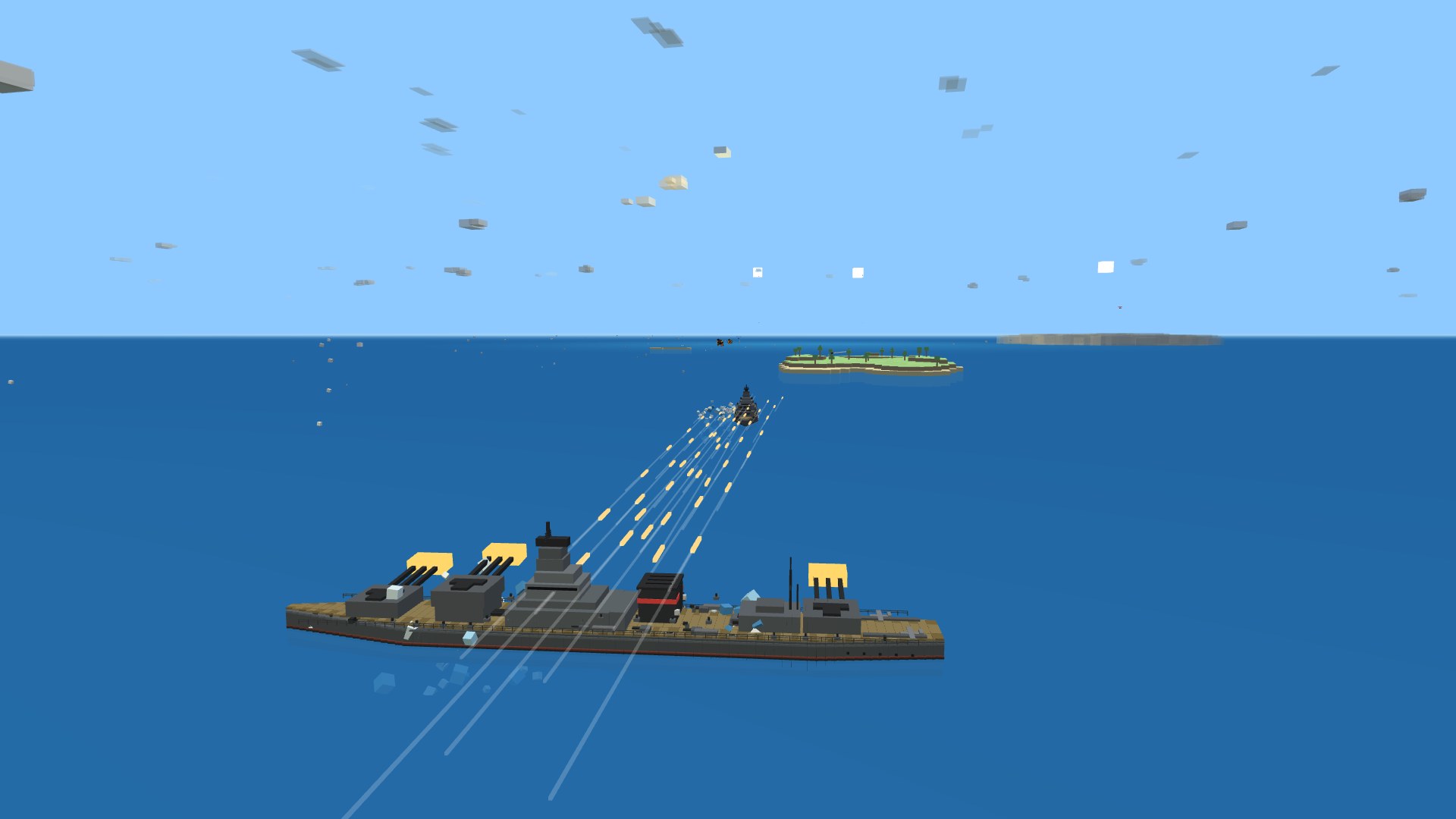
Every warship's main battery used to be a single abstract gun that loosed the whole salvo from the forecastle no matter where you pointed it. Now each hull carries its configured turret layout — the Dreadnought's A/B/X triple mounts, the Tempest's three autoloaders, the destroyer's gun houses fore and aft — and each mount has a train arc: 150° either side of its facing before the ship's own superstructure masks it. A salvo fires exactly the turrets that bear. Charge bow-on and your aft guns stay stowed — you throw a fraction of your weight of fire. Swing broadside and every mount trains out and joins. Positioning, the thing that makes naval gunnery a game, finally pays in shells.
The ship models tell the truth about it: the old baked-on turret blocks are gone, replaced by live mounts that visibly train onto your aim — and swing back to their fore-and-aft stow when the sight crosses out of their arc. A GUNS 4/6 readout under the crosshair counts your bearing barrels, and amber text nudges you to swing broadside when part of the battery is masked. A lay that no turret can reach holds fire and the reload, so the guns thunder the instant they bear instead of eating a dead cycle. Damage is budgeted across the full broadside, so the classic salvo total is what a beam-on ship throws — a bow-on one throws proportionally less.
A gunsight that projects onto the sea
A crosshair floating against open ocean tells you nothing about where a shell on a ten-second flight will fall. The sight now paints it on the water, World-of-Warships style: a gold dispersion ellipse rides the sea at the exact point the auto-ranged battery will land, wide across the line of fire by the guns' real scatter and stretched down-range where the flat arc drags the pattern long. It hugs your aim as you train, fog can't hide it, and it means a long shot is laid on the ocean — walk the ring onto a target's course, watch your splashes, correct.
Over the horizon, both ways
Bots used to out-range the visible world: they'd happily shell a hull the human couldn't render, while a player's sight ray that met no water simply went dead. Two fixes, one on each side of the fairness ledger. First, the sight lashes out to maximum range: put the crosshair on the horizon and the guns lay for their full ballistic reach (8.4 km on the destroyer's rifles, 13 km on the battleship's) — the readout flags MAX, the ring turns red, and the salvo flies as far as a shell can physically travel before its fuse gives out. Second, the sea itself got deeper: the naval theater's horizon haze now sits past the guns' reach, so a spotted battleship at twelve kilometres is a silhouette you can lay on instead of a wall of fog.
And the AI now fights by your rules: it only opens fire on a spotted target. A destroyer sneaking inside its concealment is genuinely unseen — the bots have to close the range, catch your firing bloom, or hang a star shell over you before their batteries speak. The same turret arcs bind them too: a bot caught in a stern chase throws the same thin fire a player would.
A binocular view worth using
The Z gunsight got the same treatment. The camera now climbs to a spotter's vantage above the director and magnifies deep — enough that a battleship at the guns' full reach is a target, not a speck. The old crosshair is gone, replaced by the horizontal lead scale: a long line with rising notches, minor every half unit and numbered majors, where one unit is the distance a hull covers during one shell flight — "lead two" is something you can learn. And the vertical axis is a range dial: the aim range walks smoothly up and down under the mouse and the sight follows it out across the water, so a long shot is a place on the sea instead of a guess at holdover. The sea horizon itself was pushed out past the longest guns in every weather: if the enemy can shoot you, you can see it.
Calmer seas
Three quality-of-life reins on the early game. The smoke screen is shelved for now — enemy destroyers spammed clouds and poured fire out of them with impunity; concealment now rides spot range, your firing bloom and island cover alone. Bots reload slower than you do, and their rapid secondaries have been throttled hard, so three of them concentrating on you no longer reads as a machine gun. And shell contrails were redrawn as thin white streaks that arc across the sky along each round's path — long clean vapor lines instead of fat smoke puffs blotting out half the screen.
The line is open
Progression used to gate the cruiser behind five sinkings and the battleship behind fifteen — which mostly meant new captains never touched the big guns. The whole fighting line is now free from the first sortie: destroyer, cruiser or battleship, pick your trade-off and sail. One hull keeps a lock: the premium Tempest, forty sinkings' worth of career, autoloading turrets that cycle in barely over a second, and never in AI hands — a flag that says the captain flying it earned it.
Net effect: the duel is the game now. You fight for the broadside while showing the enemy your belt as briefly as you dare, you lead a mover by walking the gold ring onto her course, and when shells come arcing out of the haze you can finally answer them.