Casting off: a separate naval theater and its ocean map
We tried to cram everything — planes, tanks, fleets — onto one map and call it combined arms. It got muddy. So we're taking a different tack: ground and sea are becoming separate game modes with their own maps. First up, the sea. Here's the naval theater, and why it starts with the map.
Why split the modes
The air map is an archipelago built for dogfights: a central island, a ring to hold, bases in opposite corners, roads and convoys threading the land. Bolting a real surface-fleet battle onto that same terrain meant ships squeezed into whatever water was left between the hills, guns and bridges and balloons everywhere, and two completely different games fighting over one set of rules. Pulling them apart lets each be itself. The naval theater is its own mode with its own map — the air game stays exactly as it was, and the sea gets a world built for ships.
A map made for ships
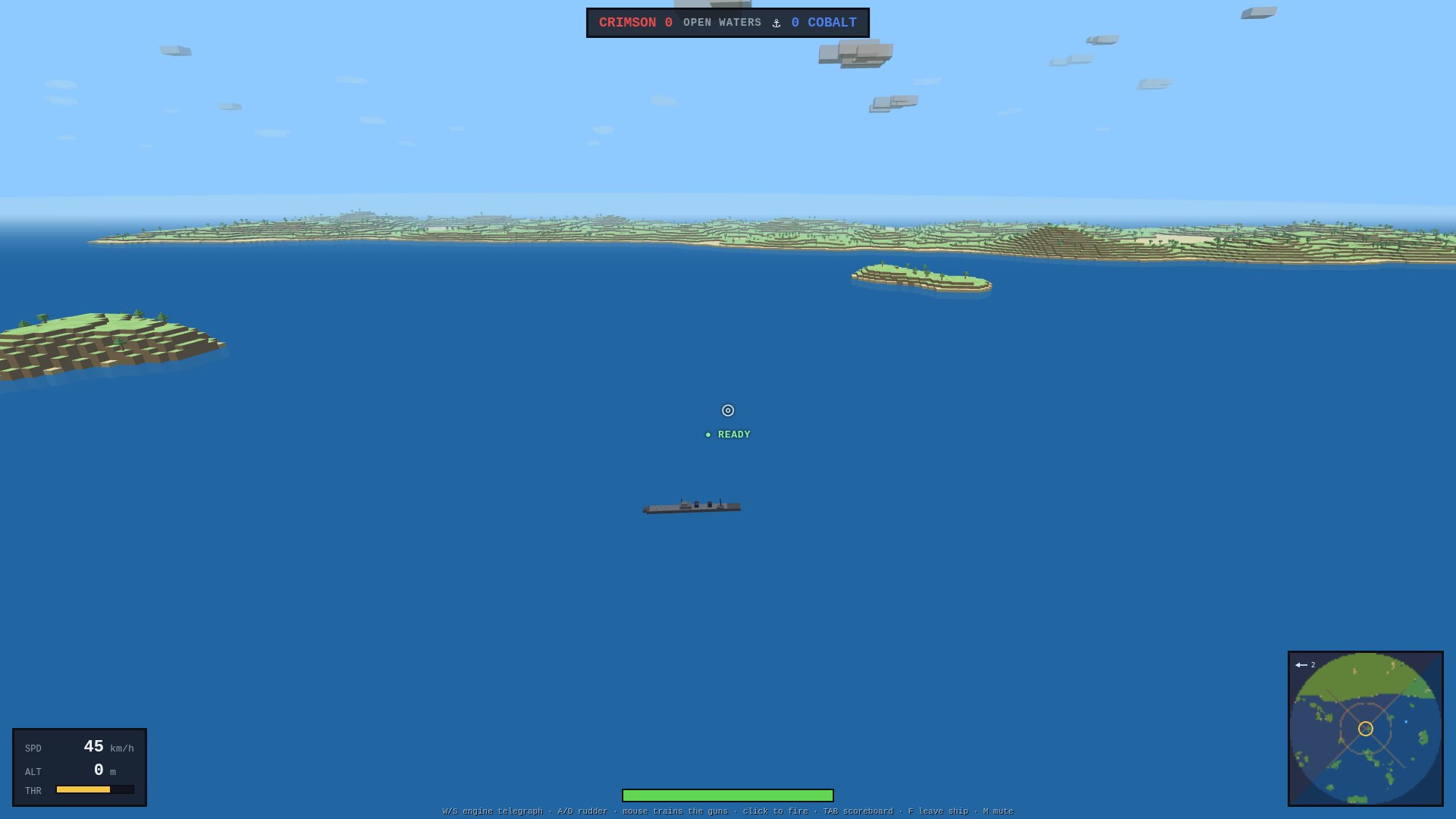
World of Warships taught everyone what a good naval map wants: open water to maneuver, islands to fight around, and a coastline to anchor the edges. So where the air map crowds land into the center, the naval map keeps the middle mostly sea, scatters low islands across it for cover, and raises a continental coastline along the north edge with ragged bays and headlands to slip behind. Same blocky world, completely different sea.
Ships that handle like ships
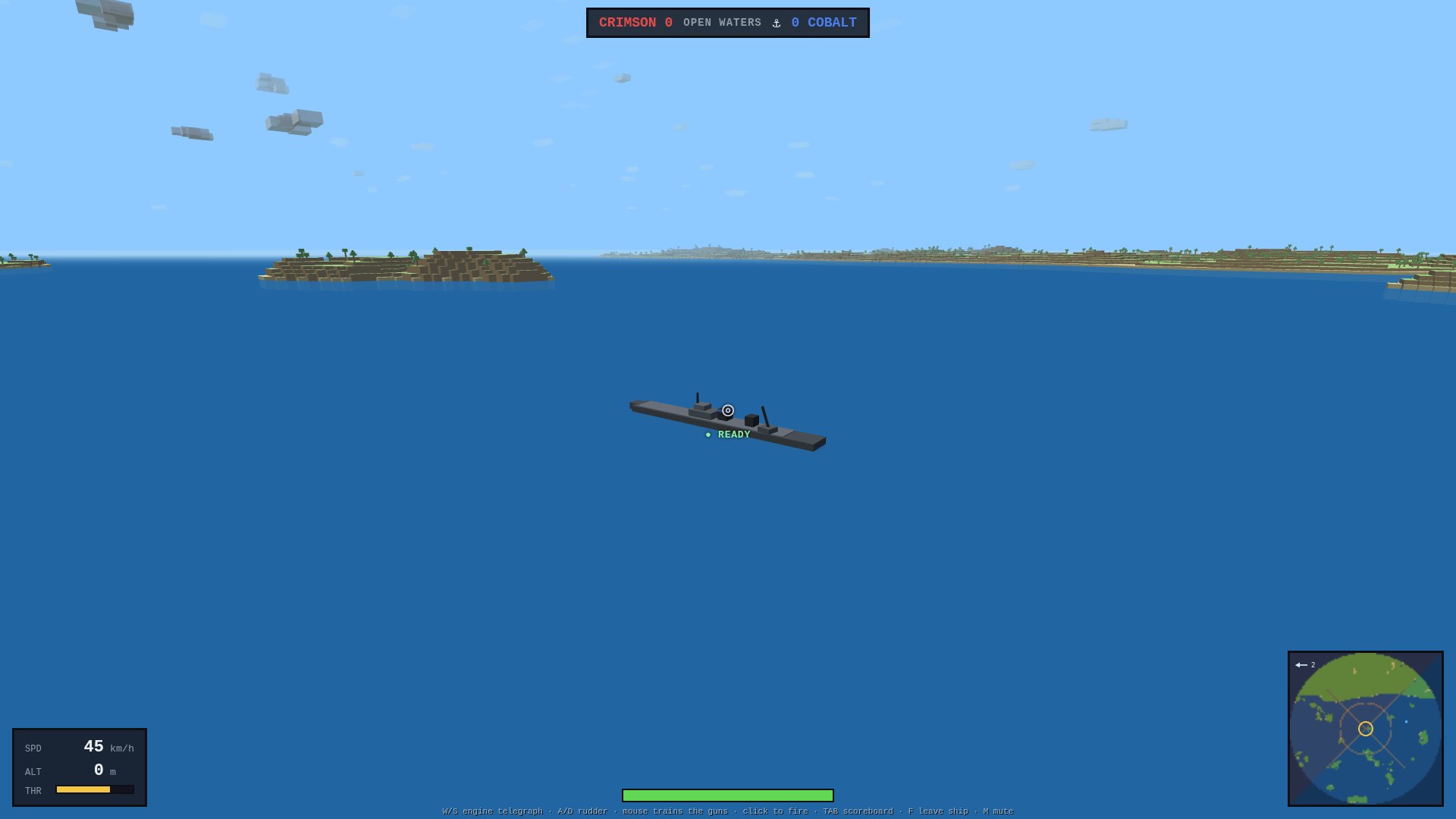
You don't fly in the naval theater — you take the bridge. Pick a hull from the spawn screen (a fast, nimble destroyer or a heavier, better-armored cruiser) and put to sea on your team's flank. The controls borrow the muscle memory of the existing crewable vehicles, but the physics underneath are deliberately naval:
- The throttle is an engine telegraph. W and S order more or less power; the hull spools toward it and coasts down slowly. There is no stopping on a dime.
- The rudder lags and needs speed. A and D order a turn, but the rate eases in and scales with how fast you're going — a near-stopped ship barely answers her helm, so you learn to plan a turn a ship's length ahead.
- The guns train off the bow. The mouse swings the main battery independently of your heading, so you hold a course and walk fire onto a target at the same time.
- The shore is the shore. Nose into an island and you run aground and stall, just like you should.
What's next
This is the keel, not the finished ship. The map and the handling are in; the deep World-of-Warships systems come next — HE and AP shells with real penetration against an armored belt, citadel hits, fire and flooding with a damage-control party to fight them, and proper ship-vs-ship gunnery and torpedoes. We started with the map because everything else floats on top of it. Cast off and have a look around — the sea's wide open.