The panel comes alive
Until now the six cockpits were beautiful and dead: every needle parked on its peg while you dived through a furball. Now the panel flies with you. The dials read your speed, height and climb in each airframe's own units, the horizon tips with your bank, and the stick leans the way you're pulling.
Glance down
Press C in the Spitfire, the P-38, the B-17, the Bf 109, the Fw 190 or the Corsair and look down at the panel. Everything that moved in the real aircraft moves here:
- the airspeed needle winds round as you dive and sags back as you climb;
- the altimeter's long hand turns once every thousand, and its short hand keeps count of the thousands;
- the climb needle swings up from nine o'clock in a zoom and down in a dive, then pins on its stop when you're going straight down;
- the turn needle leans the way the nose is swinging;
- the artificial horizon's bar tips with your bank and drops as the nose comes up, so in cloud or at night it still tells you which way is up;
- the compass card holds north as you turn round it;
- the rev counter and boost gauge climb as you open the throttle.
Hold the right mouse button (drag on a phone) to tip your head down for a proper look.
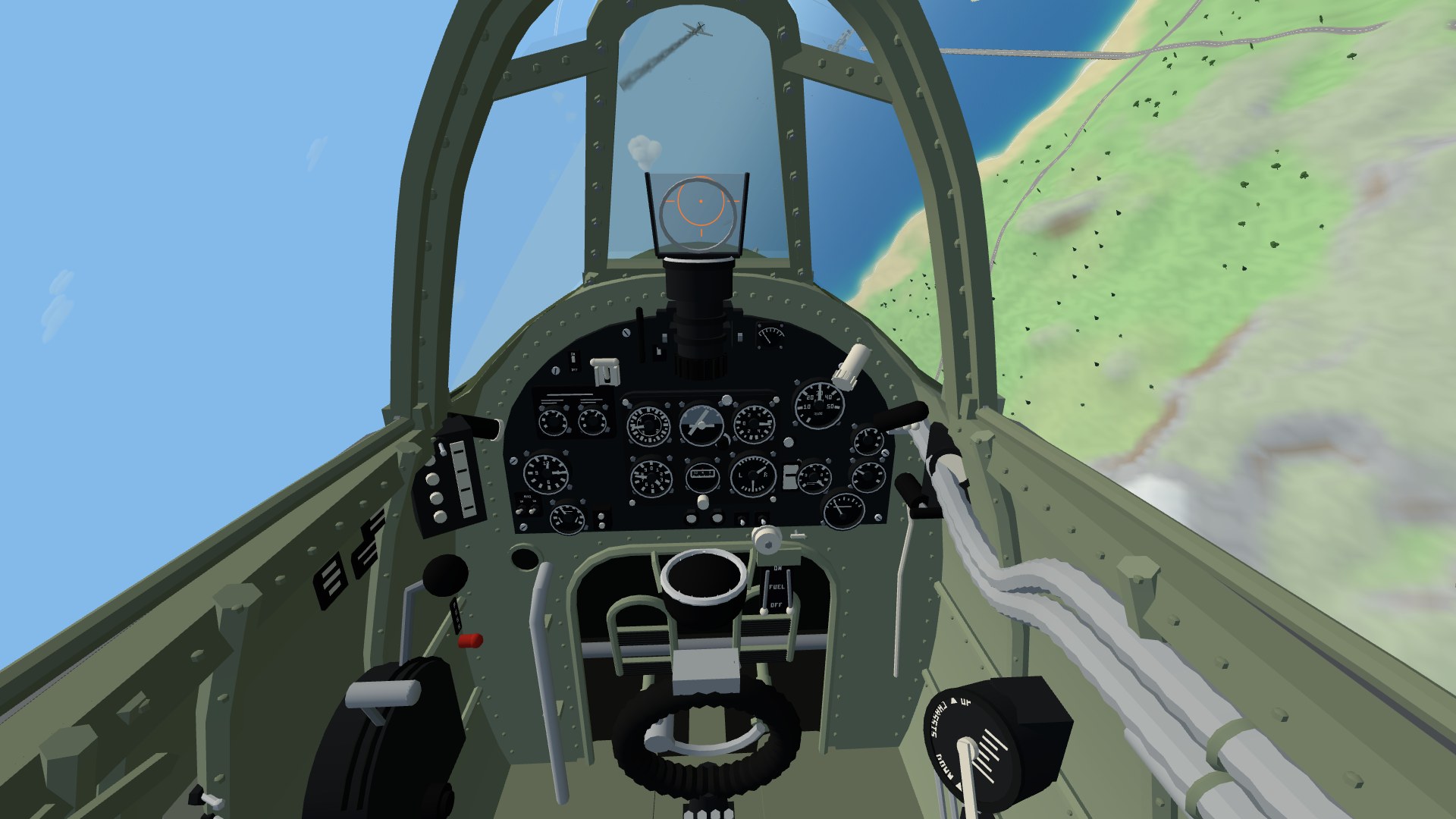
Every panel reads in its own units
Each dial reads against the figures painted on its own face. The Spitfire, the P-38 and the B-17 read miles an hour and feet. The Corsair reads knots, the way the Navy flew. The Bf 109 and the Fw 190 read kilometres an hour and metres. The Spitfire's boost gauge reads in pounds, the German fighters' in ATA, and the American engines' in inches of mercury. So 400 on the 109's airspeed dial is a lot slower than 400 in the P-38.
The B-17's four engines each have their own rev counter and boost needles, and all four throttle levers move together when you open up.
Hands and feet
The stick leans back when you pull and over when you roll. In the P-38 and the B-17, the column rocks and the wheel turns. On the Fortress, the copilot's controls move with yours. The rudder pedals go forward on the side you're kicking, and the throttle slides forward from its stop as you open it.
When the engine is hit
A hurt engine runs rough, and you can see it: the rev counter and the boost needle shake about their reading, and the harder the engine is hit, the worse they shake. When the engine dies, or the tank runs dry, the rev counter falls to zero and the boost gauge settles on the pressure of the outside air. Glance at them when the nose goes quiet: they'll tell you whether it's time to glide home or bail out.